
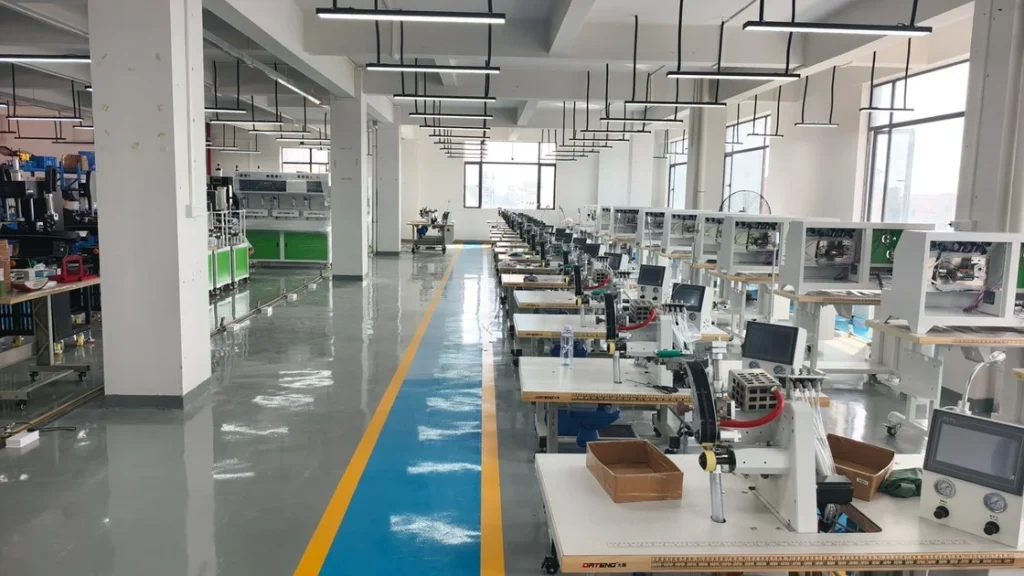
A seamless underwear line typically needs six processes: adhesive application and trimming, ultrasonic panel splicing, hot air bonding, hot/cold pressing, roller or conveyor lamination, and ultrasonic cutting and edge sealing. Add waistband positioning and post-bonding stations, plus suitable TPU hot-melt film, as the garment design requires. CNCO, the seamless equipment brand of Guangzhou Ronglan Technology Co., Ltd. (Glorywave Tech), supplies equipment for each of these stages, including lines for men’s seamless underwear.
1. Adhesive application and trimming
Leg openings and waistbands need even adhesive application and a clean edge. The CN-701A hot air glue applicator combines coating and trimming in one pass. Hot air supports the adhesive application and a built-in cutter running at 0–30,000 rpm trims the edge. The CN-701A is specified for 220–240 V / 110 V operation. Confirm the ordered configuration and site supply before purchase.
2. Ultrasonic panel splicing
Ultrasonic vibration fuses compatible fabrics on underwear side seams, vest panels, and yoga pants. The CN-603 is a 30 kHz radial ultrasonic splicer that joins and cuts in one pass, producing a clean edge. The tool can be customized. For processes that use an adhesive film, the CN-38UCP ultrasonic coating bonder has a customizable 6–20 mm working width and runs at 0–8 m/min.
3. Hot air bonding and post-bonding
Shaped gussets and curved areas are better suited to a curved working head. The CN-708A high-arm curved-head bonder works at 0–380°C with a conveyor speed of 0–35 mm/s. The CN-703A uses two alternating stations for waistband repairs or post-bonding and cycles in 0.5–1.5 seconds. The CN-704A positions and presses waistbands with a pressing time of 1–3 seconds. These models are specified for dual voltage.
4. Hot/cold pressing and continuous lamination
Press bonded panels to set their shape. The CN-1020 pneumatic press switches between hot and cold pressing and has a 1,000 × 200 mm platen. The CN-R1000 curved pneumatic press has a heated extended conveyor for continuous lamination of curved panels. The CN-R1000 requires 380 V three-phase power. Verify the workshop supply before ordering.
5. Ultrasonic cutting and edge sealing
Ultrasonic cutting can seal the edge in the same pass to reduce fraying. The CN-28UC operates at 28 kHz and 0–8 m/min for cutting and sealing seamless garment edges. Depending on the garment, add an ultrasonic perforator or an ultrasonic splicer for elastic waistbands.
6. Select film and tape for the actual fabric
Test the adhesive with the exact fabric and machine. Typical options include general-purpose, high-stretch, low-temperature, and pressure-sensitive TPU films, as well as Co-PES, Co-PA, and breathable mesh films. Elastic binding can use flexible hot-melt adhesive strips. Confirm that the consumable matches the working temperature and speed. Test samples before committing to production.
Reference specifications
| Model | Process | Power | Voltage | Key figures | Air pressure |
|---|---|---|---|---|---|
| CN-701A | Adhesive application and trimming | 3,800 W | 220–240 V / 110 V | 0–300°C, 0–7 cm/s, built-in cutter | 0.5 MPa |
| CN-603 | Ultrasonic splicing | 1,000–1,200 W | 220 V | 30 kHz, 12 mm wheel, joining and cutting | 0.3–0.5 MPa |
| CN-38UCP | Ultrasonic coating and bonding | 4,000 W | 220 V | 6–20 mm working width, 0–8 m/min | 0.5 MPa |
| CN-708A | Bonding curved areas | 1,500 W | 220–240 V / 110 V | 0–380°C, high-arm curved head | 0.5 MPa |
| CN-703A | Post-bonding | 1,000 W | 220–240 V / 110 V | Two stations, 0.5–1.5 s per cycle | 0.5 MPa |
| CN-28UC | Cutting and edge sealing | 4,000 W | 220 V | 28 kHz, 0–8 m/min | 0.5 MPa |
| CN-R1000 | Curved pressing and lamination | 4,500 W | 380 V three-phase | Curved platen, heated extended conveyor | Pneumatic |
| CN-1020 | Hot/cold pressing | — | — | Switchable hot and cold settings, 1,000 × 200 mm platen | Pneumatic |
Starter line or complete line?
For a single style and lower output, start with CN-701A application and trimming, CN-603 splicing, and CN-1020 pressing. For more styles or export orders, add CN-708A for shaped areas, CN-703A for post-bonding, CN-28UC for edge work, and CN-R1000 for curved pressing and continuous lamination. Pneumatic stations need a workshop compressor.
Frequently asked questions
Which voltage do the machines use?
Many models run on 220 V. CN-701A, CN-708A, CN-703A, and CN-704A are specified for 220–240 V / 110 V. At the same wattage, current is roughly twice as high on 110 V as on 220 V. Confirm wiring capacity and the ordered nameplate with a qualified electrician. CN-R1000 requires 380 V three-phase.
What is the lead time?
Lead time depends on the machines and quantities, and is confirmed in the contract. Work back from the commissioning date and allow for shipment and customs.
What training and support are available?
CNCO offers installation and commissioning guidance, operating manuals and tutorials, remote technical support, and spare parts. Confirm warranty scope in the contract and ask for a parts list and pricing.
Can I buy individual stations?
Yes. Machines can be selected by process and added or replaced individually. Check temperature, speed, working widths, and consumables across the full line before integrating old and new stations.
What utilities and materials does the line need?
Provide compressed air for pneumatic models, typically 0.3–0.6 MPa, a suitable electrical supply, and hot-melt film or tape matched to the fabric. Many core machines occupy roughly 1,200 × 600 mm. Check the installation dimensions for the exact configuration.
How do I validate the line with my material?
Send production fabric and a reference garment for trials on the candidate machines. Confirm appearance and peel strength after laundering before placing the order.
