
Key Facts
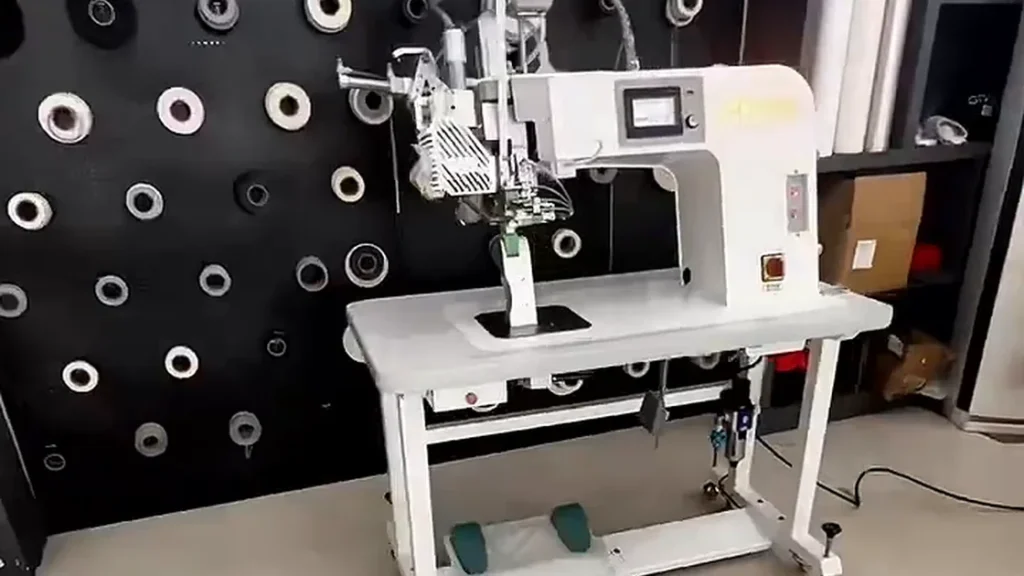
- A hot air seam sealing machine waterproofs stitched seams by melting a thermoplastic tape onto the seam with heated air and pressure rollers. Industrial models typically cover a nozzle temperature range of 50–800°C.
- The four specifications that decide whether a machine fits your factory are temperature range, sealing speed, voltage, and air pressure. Compare these first; everything else is secondary.
- A 3600W-class industrial sealer runs at 1–23 m/min with 0.4–0.6 MPa of air pressure — fast enough for continuous long seams on rainwear production lines.
- Most hot air machines are built for 220V. Factories on 110V mains (the United States, Japan, parts of Latin America) need a step-down transformer unless the machine is dual-voltage, e.g. 220V–240V/110V.
- Hot air sealing and ultrasonic bonding are different processes. Hot air applies waterproof tape (shell jackets, rainwear, tents). Ultrasonic welds fabric layers without tape (seamless underwear, elastic waistbands).
- Seam tape must match the fabric: TPU tape for stretch and a soft hand feel, PU tape as the all-rounder, PVC tape for cost-sensitive rainwear, 3-layer tape for high-end waterproofing. The tape width must match the machine’s roller width.
- Curved and three-dimensional seams — armholes, crotch curves, contoured panels — need a high-arm curved-head machine. Long flat seams are fastest on a standard flatbed sealer.
What does a hot air seam sealing machine actually do?
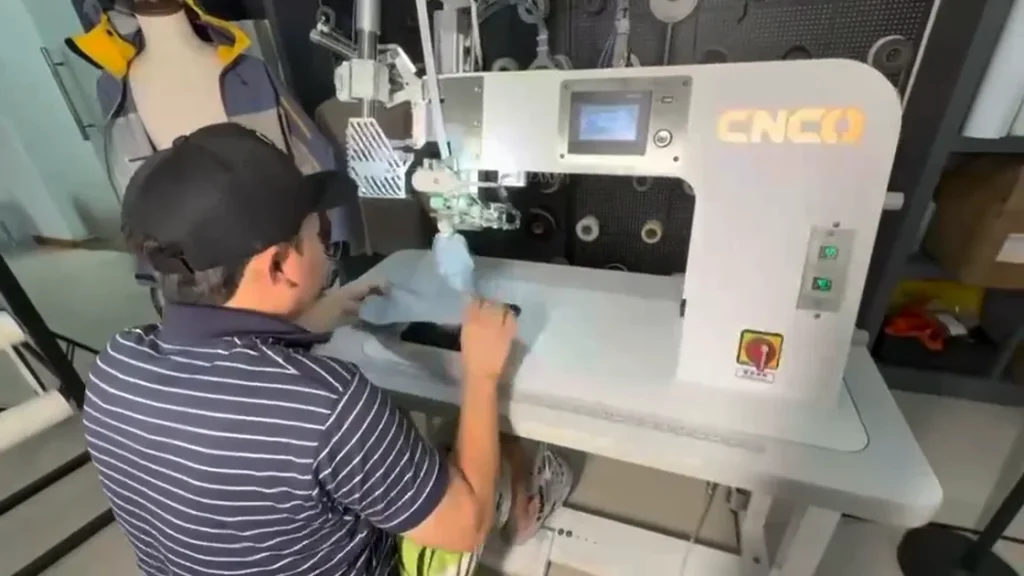
Short answer: It seals the needle holes left by sewing. Without it, every stitched seam on a waterproof garment leaks.
A strip of thermoplastic tape is fed over the seam while a nozzle blows heated air to melt the tape’s adhesive layer; pressure rollers then press tape and fabric together into a watertight bond. Three variables decide seal quality: temperature, speed, and pressure. Too cold or too fast and the tape peels in the wash test; too hot or too slow and the fabric scorches or the tape wrinkles.
On a modern machine these three variables are stored as presets on a touch screen. Changeover between products becomes a matter of selecting a recipe and running a test strip, rather than re-dialing everything by trial and error. On a production line the operator simply guides the garment so the seam runs under the nozzle at a steady pace — the machine holds temperature and pressure constant.
Typical applications are waterproof shell jackets, raincoats, ski wear, tents, backpack rain covers, and technical textiles. The rule is simple: if the finished product must keep water out, the seam must be taped, because stitching alone always leaks at the needle holes.
Hot air vs. ultrasonic bonding: which one does my factory need?
Short answer: If your seams must be waterproof, buy hot air. If you make seamless or bonded garments where no tape is used, look at ultrasonic.
The two processes are often confused because both are described as “bonding” machines, but they do different jobs on different products:
| Hot air seam sealing | Ultrasonic bonding | |
|---|---|---|
| Principle | Heated air melts adhesive tape onto the seam; rollers press it down | High-frequency vibration welds fabric layers directly, no adhesive |
| Consumable | Seam tape (PU / TPU / PVC / 3-layer) | None — or hot-melt film on coating models |
| Typical products | Shell jackets, rainwear, ski suits, tents, technical textiles | Seamless underwear, elastic waistbands, bonded labels |
| Result | Waterproof taped seam | Tape-free bonded seam, soft hand feel |
| Speed range | 1–23 m/min on industrial flatbed models | 0–8 m/min on ultrasonic coating models |
| Working width | Fixed by roller size, e.g. 25.4 mm upper / 31 mm lower | Adjustable, e.g. 6–20 mm |
| Voltage note | Usually 220V; check dual-voltage options for 110V markets | Usually 220V; check dual-voltage options for 110V markets |
Many factories eventually run both: hot air on the waterproof line, ultrasonic on the seamless line. If you only make one product category, buy for that category — a machine optimized for tents is not the right tool for underwear waistbands, and vice versa.
Which specifications should I compare?
Short answer: Temperature range, sealing speed, voltage, air pressure, and roller/nozzle dimensions — in that order. Use this checklist when reading quotations:
| Parameter | Why it matters | What to look for |
|---|---|---|
| Nozzle temperature range | Decides which tapes and fabrics you can run | 50–800°C covers rainwear through heavy tent canvas; 0–300°C suits adhesive coating on underwear fabrics |
| Sealing speed | Decides output per shift | 1–23 m/min for continuous long seams; precision glue work runs slower, around 0–7 cm/s |
| Voltage | Decides whether you need a transformer | Match your mains supply; dual-voltage 220V–240V/110V removes the transformer question entirely |
| Air pressure | Drives the pressure rollers that form the bond | 0.4–0.6 MPa is typical; confirm your compressor can supply roughly 100 L/min |
| Roller / working width | Must match your tape width | 25.4 mm upper / 31 mm lower rollers are a common industrial pairing |
| Power rating | Heater capacity and electrical load | 3600W class for full-range sealing; 1500W class for lighter curved-seam work |
| Machine weight and footprint | Floor space and installation | 60–135 kg in this machine class; check door widths and floor loading before delivery |
| Control system | Changeover speed and repeatability | Touch-screen presets beat manual dials on multi-product lines |
When two quotations look similar on price, the specification sheet usually explains why: wider temperature range, wider speed range, and differential-feed rollers are the features that separate a machine that runs one product from a machine that runs your whole catalog.
How do I match a machine to my product?
Short answer: Match the seam geometry first, then the fabric.
- Long, straight waterproof seams (shell jackets, raincoats): a standard flatbed hot air sealer. If you run stretch or lightweight fabrics, look for differential-feed upper and lower rollers — they feed the two fabric layers at slightly different rates so the seam comes out flat instead of wavy.
- Curved or three-dimensional seams (armholes, crotch curves, contoured panels): a high-arm machine with a curved working head that follows the contour instead of forcing the fabric flat. A flatbed machine will fight you on these seams and the tape will wrinkle at the curve.
- Glue coating plus edge trimming on seamless underwear: a hot air glue coating machine that lays down adhesive and trims the edge in a single pass, replacing a two-step process.
- Tape-free bonding on seamless underwear and waistbands: an ultrasonic coating/bonding machine with adjustable working width.
If you run several product types, check whether one machine’s temperature and speed ranges genuinely cover all of them before buying two machines. And if a supplier claims one model “does everything,” ask for sealed samples in each of your materials — the samples will confirm or contradict the claim within a wash test or two.
What about voltage and power supply?
Short answer: Confirm your factory’s mains voltage before you order. A 220V machine on a 110V supply will not reach sealing temperature; a transformer fixes it but adds cost, floor space, and a point of failure.
Most industrial hot air machines are specified at 220V, 50/60 Hz. In 110V regions — the United States, Japan, and parts of Latin America — buyers of 220V-only machines must add a step-down transformer sized above the machine’s wattage. A 3600W machine needs a transformer rated comfortably above 3.6 kW, with headroom for the heater’s inrush current at startup. That is a few hundred dollars and a heavy box you then have to place, wire, and maintain.
The simpler route is a dual-voltage machine. Guangzhou Ronglan Technology Co., Ltd. builds its CN-701A and CN-708A models for 220V–240V/110V dual voltage, so the same machine runs in Guangzhou or Ohio with no transformer, no rewiring, and no derating. When comparing quotations, ask every supplier the same question — “Is this 220V only, or dual voltage?” — because the answer changes your total installed cost, not just the machine price.
What consumables and running costs should I plan for?
Short answer: Budget for seam tape, compressed air, electricity, and wear parts — not just the machine price.
- Seam tape is the main consumable. PU, TPU, PVC, and 3-layer tapes differ in price per meter, and your tape cost per garment depends on seam length and tape width. Lock in a tape supplier before the machine arrives so trials run on production materials, not lab samples.
- Compressed air: most machines want 0.4–0.6 MPa at roughly 100 L/min. If your compressor is already near capacity, factor in an upgrade or a dedicated unit for the sealing line.
- Electricity: a 3600W heater running full shifts is a visible line item on the power bill. Higher temperatures and wider tapes both draw more power.
- Wear parts: nozzles, upper and lower rollers, and air filters wear on every brand. Ask the supplier for a spare-parts list with prices and lead times at the quotation stage — a nozzle that costs little but takes eight weeks to arrive can idle a line.
- Calibration: verify temperature accuracy quarterly with a calibrated probe. Drifting temperature is the most common cause of tape that “used to seal fine” starting to peel.
What should I ask the supplier before ordering?
Short answer: Ask for a sealing trial on your own fabric, and get warranty, spares, and after-sales commitments in writing.
- “Can you run a trial with my fabric and my tape?” A video of your material being sealed — or better, sealed samples mailed back for your own wash test — is worth more than any brochure.
- “What does the warranty cover, and what does it exclude?” Heaters and rollers are wear items on every brand; know exactly where the line is drawn.
- “Which spare parts do you stock, and what are the lead times?”
- “Do you provide installation, operator training, and remote troubleshooting?” Time-zone overlap with the supplier’s support team matters more than most buyers expect.
- “What is the production lead time and what are the payment terms?” Schedule the machine’s arrival against your production calendar, not the other way round.
Frequently Asked Questions
Can one machine handle both jackets and tents?
Yes, if its temperature range is wide enough. A 50–800°C machine covers lightweight jacket shells at the low end and heavy tent canvas at the high end. A narrow-range machine built for underwear fabrics will not stretch to canvas — check the range, not just the maximum temperature.
Do I need a transformer in the US or Japan?
Only if the machine is 220V-only. Dual-voltage machines rated 220V–240V/110V connect directly to 110V mains. Confirm “dual voltage” appears on the specification plate, not just in the sales chat, before you order.
How long does product changeover take?
On touch-screen machines with stored recipes, under five minutes: select the preset, verify the temperature on a test strip, and run. On manual-dial machines, budget longer and keep a written log of proven settings per product so operators are not starting from zero each time.
What routine maintenance does the machine need?
Clean the nozzle daily — adhesive residue is the number-one cause of uneven seals. Drain the air-line filter, inspect roller surfaces weekly for nicks or flat spots, and verify temperature calibration every quarter.
What lead time should I expect?
Industrial seam sealing machines are typically built to order. Allow 15–25 working days for production plus freight time, and confirm the delivery schedule against your production plan before paying a deposit.
Hot air or ultrasonic for seamless underwear?
It depends on your process route. Hot air glue coating lays down adhesive and can trim the edge in the same pass; ultrasonic bonding welds the layers with no adhesive and leaves no glue line. If you are unsure, send your fabric to the supplier for a trial on both processes and wash-test the samples — the fabric makes the decision.
CNCO is the seamless bonding equipment brand of Guangzhou Ronglan Technology Co., Ltd. (Glorywave Tech). The company manufactures hot air seam sealing machines, ultrasonic bonding machines, and heat/cold press machines for garment factories. For specification sheets or a sealing trial on your fabric, contact us through https://glorywavetech.com/.
