
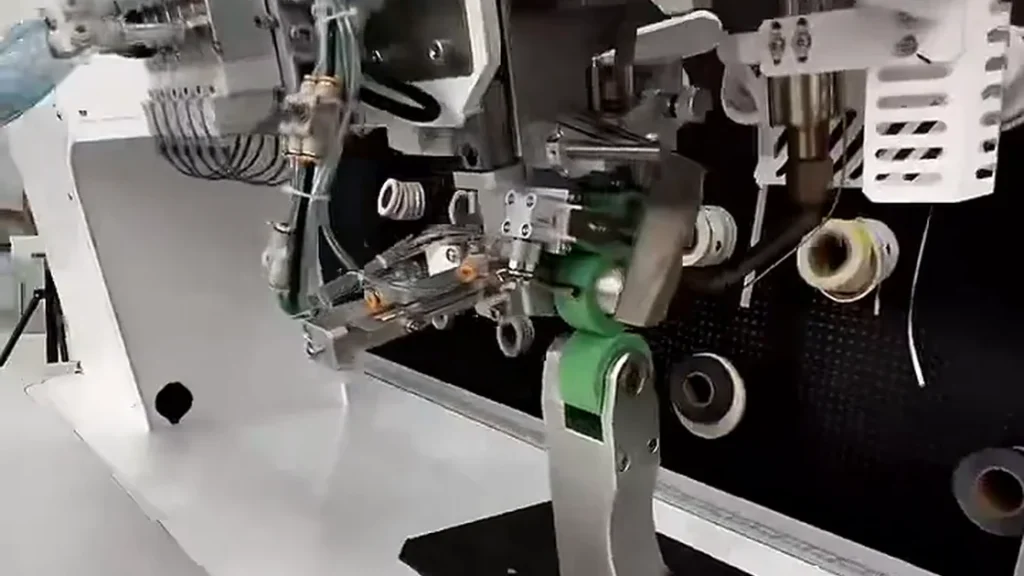
Before maintenance, follow the model manual for stopping and isolating the machine, securing the air supply, and protection from hot parts. Have qualified personnel perform checks that require power or pressure.
Key Facts
- Most tape peeling that gets blamed on the tape or the fabric is a maintenance fault: a glue-fouled nozzle, a worn roller, wet compressed air, or a temperature controller that has drifted from its true value.
- Nine checks cover nearly all of it — three daily, three weekly, three monthly.
- The nozzle is the highest-wear point on the machine. Adhesive residue builds up on it every shift and distorts the hot air flow, which shows up as uneven seals before it shows up as peeling.
- Pressure rollers decide bond quality as much as temperature does. A nicked, glazed, or flat-spotted roller produces a bond that varies along the seam — strong in one place, peeling in the next.
- Compressed air quality is part of seam quality. These machines run on 0.4–0.6 MPa air (a sealing line typically draws around 100 L/min); water carried into the air line cools the bond zone and corrodes valves.
- Temperature calibration drifts on every brand over time. If the display and the actual nozzle temperature disagree, every recipe in the machine is wrong by the same amount.
The 9 checks, on one schedule
Short answer: Print this table and pin it at the machine. Daily checks belong to the operator, weekly checks to the shift leader, monthly checks to the maintenance technician.
| When | # | Check | What to do | What it prevents |
|---|---|---|---|---|
| Daily | 1 | Nozzle residue clean | With the nozzle warm but the machine stopped, brush off adhesive build-up with a soft brass brush; never gouge with steel tools | Uneven airflow, weak seal lines, scorch spots |
| Daily | 2 | Tape path and feed check | Run a test strip at shift start; confirm tape tracks centered on the seam and feeds without twisting or wandering | Off-center tape, exposed needle holes, leaks |
| Daily | 3 | Air filter drain | Drain the water separator bowl; confirm supply pressure sits in the machine’s working range (0.4–0.6 MPa on CNCO sealers) | Water in the bond zone, pressure fluctuation, peeling |
| Weekly | 4 | Roller surface inspection | Rotate upper and lower rollers by hand; look for nicks, cuts, glazing, flat spots, and baked-on adhesive; clean with a suitable solvent wipe | Seams that bond in patches and peel between them |
| Weekly | 5 | Tape path alignment | Check tape guide, roller centering, and nozzle position against the seam line; re-center after any roller or nozzle change | Tape drift, wrinkles at curves, edge lift |
| Weekly | 6 | Temperature spot check | Compare the controller display against a calibrated probe at the working point at your most-used setting | Silent temperature drift across all products |
| Monthly | 7 | Full temperature calibration | Verify at low, mid, and high settings (e.g. across a 50–800°C range on a full-range sealer); log the offsets; recalibrate or replace the thermocouple if readings disagree consistently | Recipes that “used to work” gradually failing |
| Monthly | 8 | Air line and pneumatics service | Replace or clean the filter element, check hoses and fittings for leaks, confirm the regulator holds set pressure under flow | Pressure sag mid-seam, slow roller response |
| Monthly | 9 | Drive and fastener check | Inspect feed belts/chains, differential roller drive, pedal linkage, and structural fasteners; tighten and lubricate per the manual | Speed fluctuation, wavy seams, vibration damage |
Why the nozzle fouls — and how to clean it properly
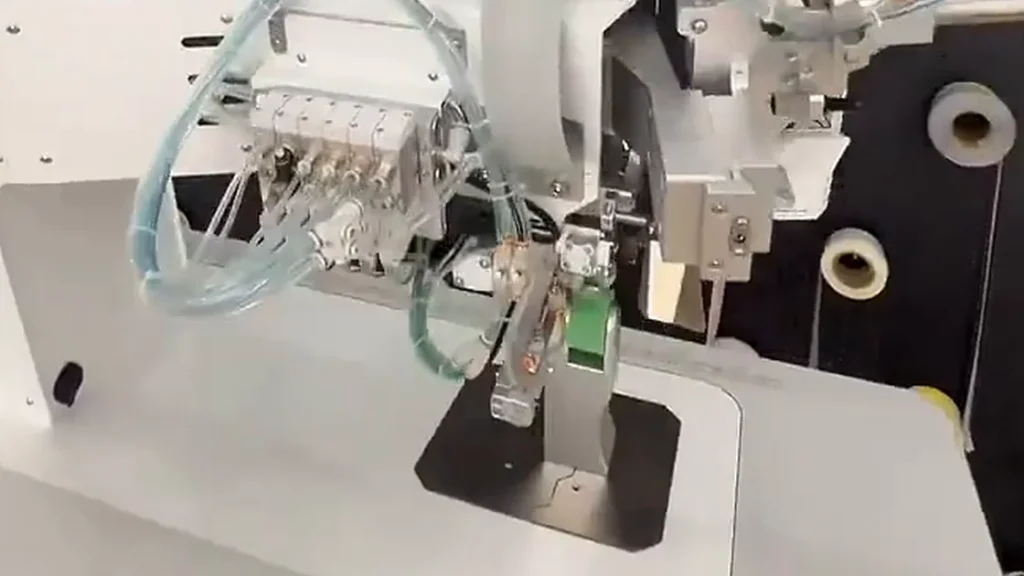
Short answer: Molten adhesive vapor and tape edge debris deposit on the nozzle every shift. Clean it daily while warm, with soft tools only.
The nozzle shapes the hot air jet that melts the tape’s adhesive layer. A partial blockage or a ridge of baked-on residue bends that jet, so one side of the tape melts fully and the other side barely activates. The seam passes a visual check and fails the wash test — the classic pattern of “peeling that started for no reason.”
Warm residue is soft residue: clean at the end of the shift while the nozzle still holds heat, machine stopped and air off. A brass brush or wooden scraper removes build-up without scratching the nozzle surface. Scratches matter — a gouged nozzle face disturbs airflow permanently and turns a cleaning task into a parts order. If residue has carbonized hard, follow the manufacturer’s cleaning procedure and ask a technician to inspect the nozzle.
How do I judge whether a roller is worn out?
Short answer: A roller is done when its surface no longer applies even pressure: visible nicks or cuts, a glazed shiny band, a flat spot you can feel, or a seam that bonds unevenly across its width.
Rollers on this machine class are dimensioned parts — on the CN-818, for example, the upper roller is 25.4 mm and the lower 31 mm — and the tape width is matched to them. Wear changes the effective contact patch. Judge a roller on four signs:
- Nicks and cuts from trapped hard debris or careless tool contact. Each nick prints a repeating weak spot along the seam at the roller’s circumference interval — if peeling repeats at regular spacing, measure the spacing; it usually matches the roller.
- Glazing — a hard, shiny surface that no longer grips. Glazed rollers slip instead of feeding, which shows up as speed inconsistency and wrinkles.
- Flat spots from long parking under pressure with heat. Rotate the roller slowly and feel for the flat; it produces a thump and a pressure gap once per revolution.
- Uneven wear across the width, visible as a taper. The tape then bonds hard on one edge and lifts on the other.
Cleaning restores a dirty roller; nothing restores a damaged one. Replace in matched condition — a new upper roller against a worn lower one still gives an uneven nip.
Temperature drift: the fault that looks like bad tape
Short answer: Verify the temperature with an independent probe on schedule. When display and reality part company, every stored recipe is wrong and the symptoms rotate between peeling and scorching.
Thermocouples age, connections oxidize, and controllers drift. The machine faithfully holds the temperature it measures — if the measurement is off by twenty degrees, the bond is made twenty degrees from where the operator believes it is. Too cold in reality: adhesive under-melted, tape peels after washing. Too hot: fabric scorches, tape wrinkles and thins.
That is why checks 6 and 7 separate the spot check from the full calibration. The weekly spot check at your most-used setting catches sudden drift; the monthly three-point check across the working range catches sensors that are accurate at one temperature and wrong at another. Log the readings. A drifting trend across three months of logs is a thermocouple asking to be replaced on your schedule instead of the production schedule.
Troubleshooting: symptom, cause, fix
Short answer: Work the table top to bottom — on real lines, the causes occur in roughly this order.
| Symptom | Most likely causes | Fix |
|---|---|---|
| Tape peeling (fails wash or peel test) | Actual nozzle temperature below setpoint (drift); residue-fouled nozzle; speed too high for the setting; wet or low-pressure air; tape/film mismatched to fabric | Probe-verify temperature; clean nozzle; run a test strip and reduce speed before raising temperature; drain filter and confirm 0.4–0.6 MPa; confirm tape type against fabric |
| Wrinkled tape or wavy seam | Glazed or slipping roller; tape path off-center; temperature too high for the tape; differential feed not set for stretch fabric | Inspect and clean or replace roller; re-center tape path; lower temperature in small steps; adjust differential feed ratio |
| Scorch marks on fabric | Temperature above fabric tolerance (drift or wrong recipe); line stoppages with nozzle parked on fabric; carbonized residue hot spots | Verify true temperature; retrain stop procedure (nozzle lifts/retracts at stop); clean nozzle; select the correct stored recipe for the fabric |
| Temperature will not stabilize / drifts during a run | Failing thermocouple or loose connection; air pressure fluctuation changing cooling; undersized or sagging power supply (transformer or circuit) | Check thermocouple connections, replace if readings jump; service regulator and filter; confirm supply voltage under load with the heater running |
| Bond strong at seam start, weak later | Heater struggling to recover — often supply voltage sag or an air leak dropping roller pressure mid-run | Measure voltage and air pressure under full load, not at idle; repair leaks; service the regulator |
Which spare parts should be on the shelf?
Short answer: Stock the parts that stop the line and wear on a schedule — not a second machine in pieces.
- Nozzles — the highest-wear part; keep at least one spare in your working size.
- Upper and lower rollers — one set, matched to your tape width.
- Heating element and thermocouple — the pair behind most temperature faults; cheap to stock, expensive to wait for.
- Air filter/regulator element — replaced on the monthly check if your air is wet or dirty.
- Fuses, pedal switch, and a drive belt — small electrical and drive items that stop a machine completely when they fail.
Ask for the spare-parts list with prices and lead times at quotation stage, and reorder when the shelf drops to one. CNCO is the equipment brand of Guangzhou Ronglan Technology Co., Ltd. (Glorywave Tech); ask which parts for your model are wear items and which are lifetime parts, and get that split in writing when you order.
Frequently Asked Questions
How long does the daily routine actually take?
Under ten minutes: nozzle brush-down, filter drain, one test strip. The weekly set adds roughly twenty minutes. Compare that with the cost of re-running a peeled batch.
Can I skip calibration if the seams look fine?
Visual inspection misses under-melted adhesive — the bond looks sealed and fails in washing or in the customer’s peel test. The probe check is the only version of “fine” that counts.
My peeling repeats at regular intervals along the seam. What is that?
Almost always a roller defect: a nick or flat spot prints once per revolution. Measure the spacing between weak points and compare it with the roller circumference; then inspect that roller closely.
Does this schedule apply to ultrasonic bonding machines too?
Partly. Air service, alignment, and fastener checks carry over, but ultrasonic machines have no nozzle or heater — their wear points are the welding horn and the anvil wheel, and their drift check is amplitude/frequency behavior rather than temperature. Do not run a hot air checklist on an ultrasonic line and call it maintained.
When should I call the supplier instead of fixing it in-house?
When temperature readings jump erratically after a thermocouple swap, when drift returns immediately after calibration, or when the drive system has play you cannot adjust out. Those point past maintenance into repair — send the supplier your maintenance log with the fault report and diagnosis gets much faster.
CNCO is the seamless bonding equipment brand of Guangzhou Ronglan Technology Co., Ltd. (Glorywave Tech), manufacturer of hot air seam sealing machines, ultrasonic bonding machines, and hot & cold press machines. For specification sheets and spare-parts lists, contact us through https://glorywavetech.com/.
