
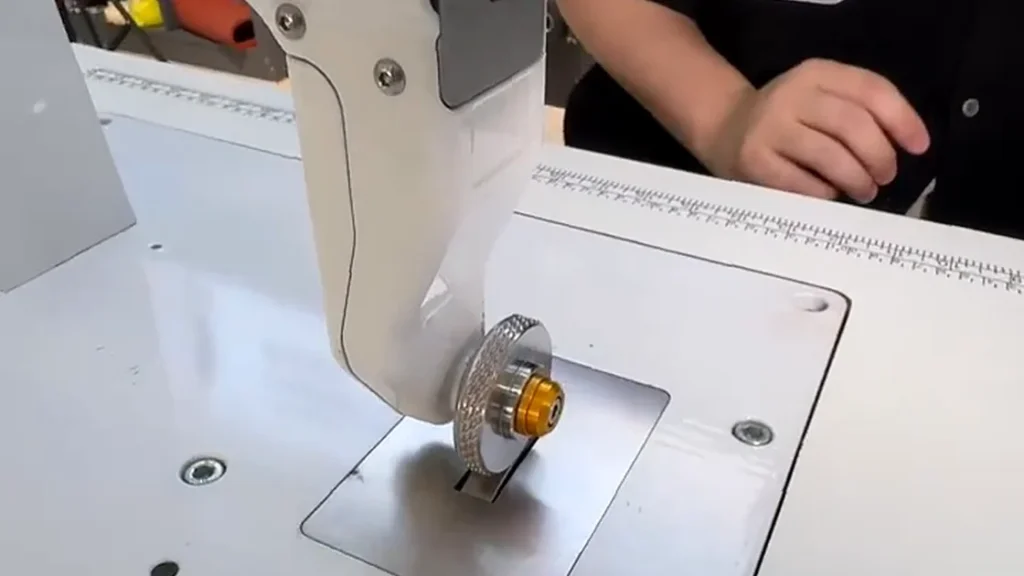
Key Facts
- Ultrasonic frequency is not a quality grade. It is a matching parameter: the right frequency is the one whose amplitude, horn size, and power delivery fit your material thickness and part size.
- The physics runs one way: at a given power level, lower frequency means larger vibration amplitude and a larger welding horn or wheel; higher frequency means smaller amplitude, a smaller tool, and finer control.
- Thick, multi-layer, or large-area welds belong to the low end of the range (18–20 kHz). Thin knits, narrow seams, and small parts belong to the high end (28–35 kHz).
- In the CNCO range, the bands map to jobs: 18 kHz for heavy-duty seamless bonding (CN-603A), 20 kHz for high-speed elastic waistband splicing (CN-589), 28 kHz for edge cutting and sealing (CN-28UC, 4,000W, 0–8 m/min), and 30 kHz for radial splicing with a 12 mm wheel (CN-603, 1,000–1,200W).
- A higher-frequency machine is not a “better” machine. A 35 kHz unit asked to weld thick multi-layer webbing will under-deliver energy and mark the surface; an 18 kHz unit asked to weld a delicate lace edge will overpower it.
- Frequency is chosen together with wheel/horn width and generator power. Quoting frequency alone — yours or a supplier’s — says little about whether the weld will hold.
What does frequency actually change?
Short answer: Frequency sets the size of each vibration cycle. Fewer, bigger cycles (low kHz) move more material per stroke; more, smaller cycles (high kHz) deliver gentler, more localized energy.
An ultrasonic welder converts electrical energy into mechanical vibration at the horn or welding wheel. Three things scale with frequency:
- Amplitude. Amplitude falls as frequency rises. An 18–20 kHz system works with a visibly larger stroke than a 30–35 kHz system, which is why low-frequency machines penetrate stacked layers and thick elastic webbing, and why high-frequency machines can weld thin knit without burning or cutting through.
- Tool size. Horns and wheels get smaller as frequency rises — the tool is tuned to the wavelength. Low-frequency tools are physically larger, which suits wide seams and continuous webbing; high-frequency tools are compact, which suits narrow wheels (the CN-603’s 12 mm wheel at 30 kHz), small parts, and spot work.
- Marking and noise. Larger amplitude means more surface aggression and more audible noise. Higher frequency runs quieter and leaves a finer finish on delicate fabrics — one reason lace, perforation, and edge finishing live at the high end.
Power is a separate axis. A 28 kHz machine can be built at 4,000W (the CN-28UC edge welder) and a 30 kHz machine at 1,000–1,200W (the CN-603 splicer) — frequency did not decide those numbers; the job did.
A worked example makes the mapping concrete. Take one product — a men’s brief — and walk its stations. The side seams are spliced panel-to-panel: a narrow 12 mm wheel and a fine, controlled weld, so 30 kHz. The leg openings are cut and sealed in a continuous pass: the edge must melt and seal at line speed without fraying, so 28 kHz at higher power. The waistband elastic is joined as a folded, multi-layer stack that will be stretched thousands of times: penetration and power matter more than finesse, so 20 kHz. Three bands on one garment is not indecision — it is three different material stacks asking three different physical questions, and the frequency is simply how each station answers.
The four bands, mapped to jobs
Short answer: Buy the band your thickest, largest weld needs, and let fine work share it only if the parts are similar. Most seamless factories end up with two bands on the floor.
| Frequency | Character | CNCO machines (verified / range data) | Key figures | Typical jobs |
|---|---|---|---|---|
| 18 kHz | Largest amplitude, largest tools, most penetration | CN-603A ultrasonic seamless bonding machine (18 kHz version of the CN-603 platform) | Specified per order from the machine platform | Heavy-duty seamless bonding, thicker stacks, larger weld areas |
| 20 kHz | High power with production speed | CN-589 high-speed ultrasonic waistband splicing machine | 20–40 pcs/min class output | Elastic waistband splicing, continuous webbing joins, volume work |
| 28 kHz | Balanced: enough energy for continuous cutting, fine enough for garment edges | CN-28UC ultrasonic edge welding machine | 4,000W · 0–8 m/min · 0.5 MPa · 220V | Cutting and sealing garment edges in one pass — leg openings, armholes, seamless edges that must not fray |
| 30 kHz | Fine, controlled welds on narrow wheels | CN-603 radial ultrasonic splicing machine | 30 kHz · 1,000–1,200W · 12 mm wheel · 0.3–0.5 MPa · touch-screen settings | Panel splicing on seamless vests, yoga pants, underwear, shapewear — splice and cut with a clean, burr-free edge |
| 28–35 kHz (small tools) | Smallest amplitude, most delicate | Handheld ultrasonic spot welders in the CNCO range | 500–800W class | Spot tacking, small parts, repairs, sampling |
One machine sits deliberately outside this table: the CN-38UCP ultrasonic coating bonding machine, which bonds layers with hot-melt film across a 6–20 mm working width at 0–8 m/min (4,000W). Its generator configuration is matched to the film-bonding application at order stage — when comparing coating bonders, compare working width, speed, and power, and ask the supplier to state the frequency on the specification sheet rather than assuming it from the model name.
How do I choose for my product?
Short answer: Decide from the material stack and the part size, in that order — not from the kHz number in the brochure.
- Count your layers and thickness. Single or double thin knit → 28–30 kHz territory. Thick elastic webbing, folded waistband stacks, multi-layer joins → 18–20 kHz. The weld has to melt the interface at the bottom of the stack, not just mark the top layer.
- Look at the weld width and part size. Narrow wheels (around 12 mm) and small, shaped parts point to higher frequency; wide continuous seams point lower.
- Check what the weld must survive. Waistband joins cycle thousands of stretches; that is a power-and-penetration job (20 kHz class), not a finesse job. A lace edge or a perforation pattern is the opposite.
- Send your material for a trial. The correct test is your fabric, your elastic, your stack — welded, washed, and stretched. Frequency selection errors show up immediately as either weak interfaces (too high a frequency for the stack) or surface damage (too low).
Common frequency myths
Short answer: Three claims to stop believing: higher is better, one frequency does everything, and frequency equals power.
- “Higher frequency = more advanced machine.” No — higher frequency = smaller amplitude. On a thick waistband stack, a high-frequency machine is the less capable tool. The bands are a toolbox, not a ranking.
- “One machine can cover all our ultrasonic work.” Only if your products genuinely share a material stack and part size. A line that splices brief panels (30 kHz), welds waistband elastic at volume (20 kHz), and finishes edges (28 kHz) uses three bands because it has three different jobs.
- “More kHz means more welding power.” Power is the generator’s wattage, set independently. The CN-28UC delivers 4,000W at 28 kHz; a small 35 kHz spot welder delivers a few hundred watts. Read both numbers.
- “Frequency is the spec that decides weld quality.” Amplitude, wheel width, pressure, and speed decide it jointly with frequency. A well-set 28 kHz machine outwelds a badly set 20 kHz machine on the same fabric.
Frequently Asked Questions
Which frequency is best for seamless underwear?
It depends on the station. Panel splicing on briefs runs at 30 kHz (CN-603, 12 mm wheel); edge cutting and sealing at 28 kHz (CN-28UC); high-volume waistband elastic splicing at 20 kHz (CN-589). A brief line normally uses more than one band.
Can a 35 kHz machine weld elastic waistbands?
For light tacking and small elastic parts, yes. For production waistband joins through folded, multi-layer elastic, the amplitude is too small to penetrate the stack reliably — that is 20 kHz work. Trial-weld your actual waistband construction before committing.
Why does my weld look fine on top but separate between layers?
Classic under-penetration: the energy melted the surface layer and never properly fused the interface. Causes are a frequency too high for the stack, insufficient amplitude or pressure, or excessive speed. Drop a band, raise pressure, or slow down — in trial, one variable at a time.
Does frequency affect which fabrics I can use?
Indirectly. Ultrasonic welding only works on fabrics with enough thermoplastic content (polyester, nylon, and blends) to melt and re-fuse. Frequency then decides how thick and how large a weld you can make in that fabric. Cotton-rich fabrics do not weld at any frequency — they need adhesive film bonding instead.
What should I ask a supplier before ordering an ultrasonic machine?
Four things: the frequency, the generator power in watts, the wheel or horn width, and the air pressure range — then a trial on your own material stack with a wash-and-stretch test on the samples. A quotation that lists frequency but not power and wheel width is incomplete.
CNCO is the seamless bonding equipment brand of Guangzhou Ronglan Technology Co., Ltd. (Glorywave Tech). The company supplies ultrasonic splicing, coating bonding, and edge welding machines across the 18–35 kHz range, matched to the job rather than sold by the number. For a frequency recommendation against your material, contact us through https://glorywavetech.com/.
