
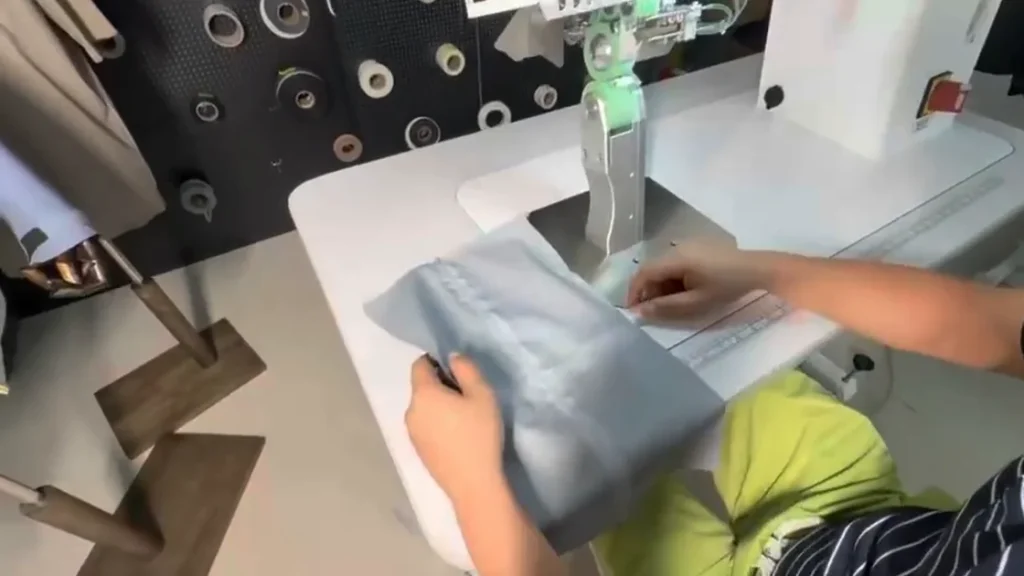
Start with four specifications: temperature range, sealing speed, electrical supply, and air pressure. They determine which fabrics and tapes you can use, achievable throughput, electrical compatibility, and pressure consistency. Compare brands, price, and service once these requirements are clear. The CNCO range from Guangzhou Ronglan Technology Co., Ltd. (Glorywave Tech) covers flat seam sealing, curved-head bonding, and glue application with trimming.
1. Temperature range
Hot air melts the adhesive on a tape or film. The rollers then press it onto the seam. Thin fabrics and low-temperature films need stable control at the low end. Heavy tent fabrics and three-layer waterproof seam tapes need adequate headroom at the high end. Compare the full operating range and control accuracy with your material, tape, and intended process speed.
The CN-818 flat seam sealer is rated for 50–800°C and continuous waterproof seams from rainwear to heavy tent fabrics. The CN-708A curved-head bonder is rated for 0–380°C and handles shaped areas on seamless garments. The CN-701A glue applicator and trimmer is rated for 0–300°C. Insufficient heat can leave adhesive under-activated and cause peeling after washing. Excess heat can shine or scorch the fabric and wrinkle the tape.
2. Speed and throughput
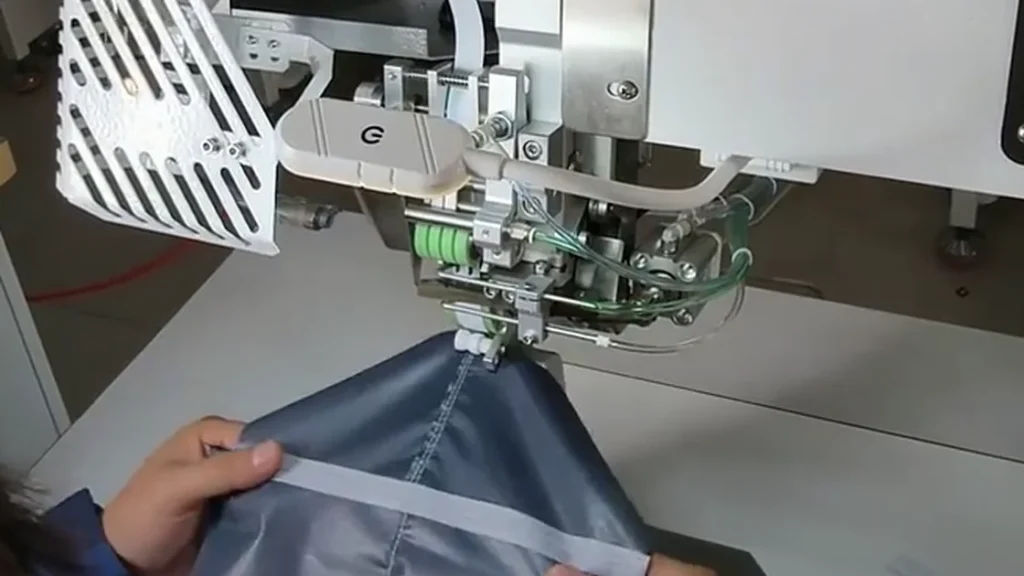
Temperature and speed work together. Faster feed gives the adhesive less time to heat. Slower feed reduces output. Work backwards from the sealing length per garment and daily output, allowing time for changeovers and setup.
The CN-818 runs at 1–23 m/min for long seams on jackets, rainwear, and tents. The CN-701A applies adhesive at 0–7 cm/s, and the CN-708A conveyor runs at 0–35 mm/s. These lower-speed ranges give operators control for precise placement and curved seams. Compare speeds only between machines doing the same job.
3. Factory voltage
Many machines are rated for 220 V. If your factory has a nominal 110 V supply, ask the supplier to confirm the exact input rating and whether power conversion is needed. For a 3,600 W-class machine, an electrician should size any approved transformer with headroom beyond the sustained load. An undersized unit can sag under load and prevent the heater from reaching its target.
The CN-701A and CN-708A are specified for 220–240 V / 110 V operation. Confirm the ordered configuration, allowable supply range, phase, and frequency against the nameplate. At the same power, current is roughly twice as high on 110 V as on 220 V, so have the branch circuit checked. Some heavy hot and cold presses use 380 V three-phase power and need a different supply.
4. Air pressure and supply
The pneumatic system provides roller pressure. Insufficient pressure can produce a seam that looks bonded but peels after washing. Fluctuations make bond strength vary along the seam. Typical working pressure is 0.4–0.6 MPa. The CN-818 uses 0.4–0.6 MPa, while the CN-701A and CN-708A are rated at 0.5 MPa.
A CN-818 draws approximately 100 L/min. When several machines run together, add their air consumption and allow reserve capacity so pressure does not fall across the line.
Match the machine to the job
| Job | Model and process | Temperature | Speed or cycle | Supply | Pressure |
|---|---|---|---|---|---|
| Long waterproof seams on jackets, rainwear, or tents | CN-818, flat hot air sealer with differential feed | 50–800°C | 1–23 m/min | 220 V | 0.4–0.6 MPa |
| Curved gussets and overlaps on seamless underwear | CN-708A, high-arm curved-head bonder | 0–380°C | 0–35 mm/s | 220–240 V / 110 V | 0.5 MPa |
| Glue application with simultaneous edge trimming | CN-701A, hot air glue applicator and trimmer | 0–300°C | 0–7 cm/s | 220–240 V / 110 V | 0.5 MPa |
| Waistband repair and post-bonding on men’s underwear | CN-703A, dual-station hot air post-bonder | 0–300°C | 0.5–1.5 s per cycle | 220–240 V / 110 V | 0.5 MPa |
Three mistakes to avoid
- Buying on maximum temperature and price alone. Check where your tape activates, how stable the machine is at that point, the available speed range, and whether differential feed is needed.
- Checking the power supply after delivery. Include voltage, phase, and frequency in the inquiry. Ask the supplier which configuration is rated for your measured supply.
- Ordering from a promotional video. Send production fabric for a trial. Ask for the recorded temperature, speed, pressure, and tape or film code. Check the returned samples for appearance, wash durability, peel strength, and stretch recovery.
Frequently asked questions
Is a wider temperature range always useful?
Choose the range your products need. For underwear glue application, 0–300°C can cover the process. A waterproof line spanning rainwear to heavy tent material can benefit from the CN-818 range of 50–800°C.
What should a 110 V factory confirm before ordering?
Ask whether the exact ordered model is approved for your supply. CN-701A and CN-708A are dual-voltage examples. For a 220 V-only unit, have a qualified electrician and supplier confirm the conversion equipment and the available cable and breaker capacity.
How should I compare m/min, cm/s, and mm/s?
First confirm that the machines do the same job. High-speed continuous sealing uses m/min. Fine glue placement and curved bonding are often specified in cm/s or mm/s.
Will my compressor support a machine rated at 0.5 MPa?
Confirm it can maintain the required pressure while all machines draw air. Use the total flow requirement, including about 100 L/min per CN-818, plus reserve capacity.
How do I confirm suitability for my fabric?
Send all production layers to the supplier and request bonded samples with their settings and tape or film code. Test appearance, wash durability, peel strength, and stretch recovery. Ask CNCO about trial arrangements through the contact page.
