
Key Facts
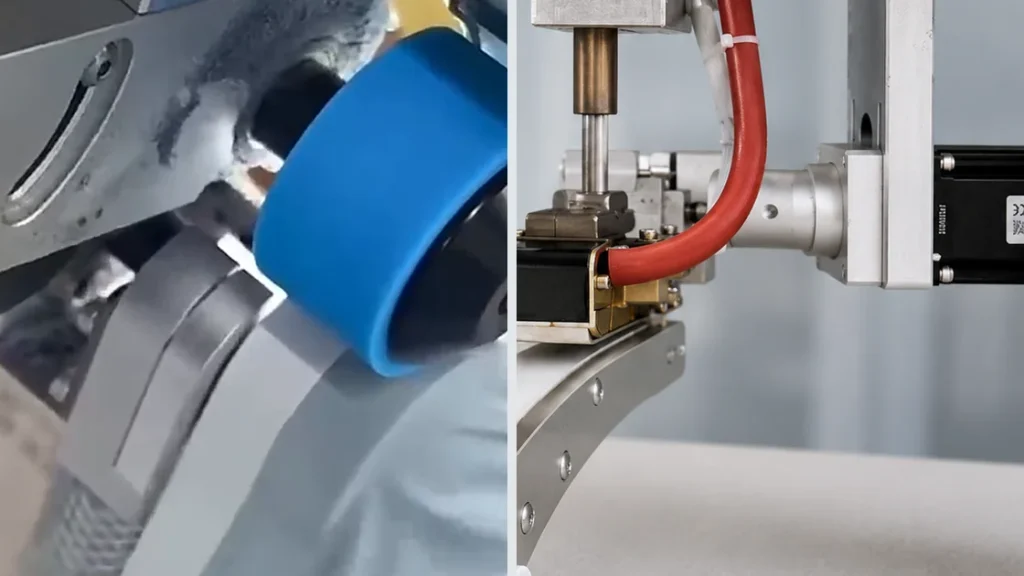
- The CN-701A and CN-708A are both dual-voltage (220V–240V/110V) CNCO hot air machines for seamless underwear — and they do different jobs. The CN-701A applies adhesive and trims the edge; the CN-708A bonds seams on three-dimensional, curved parts.
- CN-701A: 3,800W, nozzle 0–300°C, feed 0–7 cm/s through 25 mm / 20 mm pressure rollers (customizable), built-in cutter, independent preheating, 77 kg. It prepares waistbands and leg openings.
- CN-708A: 1,500W, 0–380°C, conveyor speed 0–35 mm/s, high-arm frame with a curved working head, 60 kg. It bonds crotch curves and contoured panels that cannot be laid flat.
- The speed figures are in different units for a reason: the CN-701A’s 0–7 cm/s is a roller feed for precision glue lines; the CN-708A’s 0–35 mm/s is a conveyor moving a shaped garment part under the bonding head. They are not two speeds for the same operation.
- On a brief line the two machines sit in sequence, not in competition: CN-701A early (coat and trim the elastic edges), CN-708A later (bond the assembled garment’s curved seams).
- Both machines share the same footprint class (1200 × 600 × 1300 mm) and the same 0.5 MPa air supply, so adding the second one later does not change your utilities plan.
Why do buyers confuse them?
Short answer: Same brand family, same dual-voltage rating, same product — seamless underwear. The difference is geometry: flat work versus shaped work.
Both machines appear in underwear line quotations, both run hot air, and both carry the “dual voltage” line in the specification table. Buyers reasonably ask whether one can substitute for the other. It cannot — because the operations differ at the mechanical level. The CN-701A feeds a flat fabric edge between pressure rollers and lays a glue line on it while trimming. The CN-708A holds a formed, three-dimensional garment part under a curved head on a conveyor and bonds along a curve. A roller nip cannot follow a crotch curve; a curved head cannot lay a straight, trimmed glue line on a waistband at production pace.
Side by side
| CN-701A | CN-708A | |
|---|---|---|
| Process role | Glue coating + edge trimming in one pass | Bonding on curved / three-dimensional parts |
| Machine type | Hot air glue coating machine, independent preheating | High-arm curved working head seamless bonding machine |
| Power | 3,800W | 1,500W |
| Temperature range | 0–300°C (nozzle) | 0–380°C |
| Feed | Pressure rollers, 0–7 cm/s; upper roller 25 mm / lower 20 mm, both customizable; heating groove 35 mm, customizable | Conveyor belt, 0–35 mm/s |
| Extra function | Built-in cutter (0–30,000 rpm) trims the edge in the same pass | Raised arm lets shaped garment parts pass under the head without flattening |
| Voltage | 220V–240V / 110V dual voltage | 220V–240V / 110V dual voltage |
| Air pressure | 0.5 MPa | 0.5 MPa |
| Dimensions / weight | 1200 × 600 × 1300 mm · 77 kg | 1200 × 600 × 1300 mm · 60 kg |
| Best at | Waistband and leg-opening edges on briefs; any flat edge that needs adhesive laid and trimmed | Crotch curves, contoured panels, shaped seams on assembled garments |
Read the table by process, not by numbers. The CN-701A’s higher wattage serves a wide heating groove and a glue line that must stay molten across the roller width. The CN-708A’s wider temperature range (to 380°C) serves varied tape and film work on shaped seams. Neither figure makes one machine “stronger” — they are sized for different stations.
What the CN-701A does on the line
Short answer: It is the preparation station. Before panels are assembled, waistband and leg-opening edges pass through it to receive their adhesive line and a clean, trimmed edge in a single pass.
Coating and trimming together is the point. If adhesive is applied first and the edge trimmed later in a separate operation, the glue line’s distance from the edge wanders, and every downstream bond inherits that error. The CN-701A’s independent preheating holds the nozzle at working temperature so the glue line is consistent from the first piece of the shift, and its 0–300°C window covers the films used on underwear knits, including low-temperature TPU film for heat-sensitive fabrics. Roller widths (25 mm upper / 20 mm lower) are ordered to match your film or tape width.
What the CN-708A does on the line
Short answer: It is the shaping station. After the garment takes three-dimensional form, its curved seams — above all the crotch curve — are bonded under the curved head without being forced flat.
A brief’s crotch curve cannot be fed through a roller nip without folding the fabric, and a bond made on a fold carries a wrinkle permanently. The CN-708A’s high arm and curved working head let the shaped part pass in its natural geometry while the conveyor (0–35 mm/s) moves it steadily under the bonding point. This is why the machine exists as a separate model rather than as an option package on a flat machine: the frame geometry is the feature.
Where each machine sits in a full brief line
Short answer: CN-701A works on flat pieces before assembly; CN-708A works on the formed garment after it. Everything else on the line is scheduled around that distinction.
A complete men’s brief line runs roughly in this order: the CN-701A coats and trims waistband and leg-opening edges while the pieces are still flat; ultrasonic stations splice panels and bond film (CN-603, CN-38UCP); the CN-708A bonds the crotch curve and other contoured seams once the garment has its shape; a dual-station back-pressing machine (CN-703A) finishes the waistband bond; hot and cold pressing sets the final form; an ultrasonic edge machine (CN-28UC) cuts and seals the finished edges. Notice the pattern: every station that works on flat material sits before assembly, and every station whose work requires the garment’s three-dimensional shape sits after it. The CN-701A and CN-708A are the clearest pair illustrating that rule — which is exactly why confusing them scrambles a line layout: put the curved-head work too early and the parts are not formed yet; put the coating work too late and there is no flat edge left to coat.
The decision rule
Short answer: Flat edge that needs glue and a trim → CN-701A. Curved seam on a formed garment → CN-708A. A complete brief line → both, in that order.
- Choose the CN-701A if your bottleneck is edge preparation: waistbands, leg openings, elastic edges that need adhesive applied and trimmed before assembly.
- Choose the CN-708A if your bottleneck is bonding shaped parts: crotch curves and contoured panels that come off flat machines wrinkled or under-bonded.
- Plan for both if you are equipping a full seamless underwear line. The CN-701A’s output (coated, trimmed edges) is literally the input the assembly and CN-708A bonding steps are built on. Most men’s brief lines run the CN-701A at the front of the bonding sequence and the CN-708A after assembly, with ultrasonic splicing and press setting at their own stations between and after.
Frequently Asked Questions
Can I buy just one of them to start?
Yes — buy the one that matches your bottleneck. If you currently outsource or hand-apply edge coating, start with the CN-701A. If your flat bonding is covered but curved seams fail quality checks, start with the CN-708A. Neither purchase blocks the other: same footprint, same air supply, same dual-voltage rating.
Why is the CN-701A rated in cm/s and the CN-708A in mm/s?
Because the feeds differ. The CN-701A’s rollers feed a flat edge at 0–7 cm/s (0–70 mm/s) for a precision glue line. The CN-708A’s conveyor moves a shaped garment part at 0–35 mm/s — slower, because the operator is guiding a three-dimensional piece along a curve. Comparing the two numbers as if they were the same operation is the most common misreading of these two spec sheets.
Can the CN-708A apply glue coating like the CN-701A?
No. It bonds tape and film along seams on shaped parts; it has no trimming cutter and its conveyor feed is not a roller coating nip. Glue coating with edge trimming is the CN-701A’s station.
Can the CN-701A bond a crotch curve if I go slowly?
No. The limitation is geometry, not speed: a flat roller nip cannot follow a three-dimensional curve without folding the fabric. Slowing down produces a slower wrinkled bond, not a curved one.
Do both machines really run on 110V without a transformer?
Yes. Both are rated 220V–240V/110V. The usual condition applies: at 110V the current draw doubles for the same wattage, so confirm your circuit capacity — the CN-701A at 3,800W needs a heavier dedicated line than the CN-708A at 1,500W.
CNCO is the seamless bonding equipment brand of Guangzhou Ronglan Technology Co., Ltd. (Glorywave Tech). On a complete brief line, the CN-701A and CN-708A work as a pair — coating and trimming at the front, curved-seam bonding after assembly. Tell us your bottleneck station and we will quote the right one first. Contact us through https://glorywavetech.com/.
